Supreme Court rules Trump Big Bend border wall construction can continue
National News

Audio By Carbonatix
5:36 PM on Monday, November 9
(The Center Square) – The U.S. Supreme Court on Monday ruled against Texans trying to stop the Trump administration from building a border wall system in the Big Bend region of Texas.
The unsigned ruling states that Justice Ketanji Jackson is the only justice who would deny the Trump administration’s application for a stay to reverse a lower court ruling.
At issue is a lawsuit filed in the Western District of Texas against the administration arguing waivers signed by Department of Homeland Security secretaries to bypass dozens of federal and state laws are unconstitutional.
Both DHS secretaries Kristi Noem and Markwayne Mullin invoked Section 102 of the Illegal Immigration Reform and Immigrant Responsibility Act of 1996 (IIRIRA) when they signed waivers to bypass state and federal laws protecting the environment, air and water, historic landmarks, Indian burial grounds, endangered rivers, lands and species, The Center Square reported.
They argued the U.S. Customs and Border Protection Big Bend Sector “is an area of high illegal entry” despite CBP consistently reporting the lowest illegal crossings in the sector along the entire southwest border and in Texas. The sector spans more than 500 miles along the most rugged and remote terrain in Texas.
During the Biden administration, the Big Bend Sector reported the greatest number of illegal entries in its history but still among the lowest in the country, between half of one percent and two percent of all crossings, according to CBP data. Apprehensions in Big Bend National Park were less than half of one percent. Under the Trump administration, the lowest number of illegal entries were reported in U.S. history.
Several groups sued, including the Center for Biodiversity, arguing the DHS waivers violate the “Major Questions Doctrine,” which holds that federal agencies can’t legally implement major policy decisions unless authorized by Congress. The lawsuit also argues historically low Big Bend Sector illegal crossings don’t justify the reasons given for the waivers. The district court agreed, halting border wall construction, stating the Major Questions Doctrine needed to be answered.
Because the Fifth Circuit Court of Appeals lacks jurisdiction in the case, the Trump administration filed an emergency petition with the Supreme Court. The administration argues the claims were baseless and the ruling was faulty.
The court issued a five-page unsigned ruling stating Section 201 of the IIRIRA grants the DHS secretary broad authority to construct border barriers and roads “to deter illegal crossings in areas of high illegal entry into the United States.”
It also authorizes the secretary “‘to waive all legal requirements’” as “‘necessary to ensure expeditious construction’” of those barriers and roads “and sharply limits judicial review of all claims arising from such waiver determinations,” the court held. Specifically, the statute provides that “‘[a] cause of action or claim may only be brought alleging a violation of the Constitution of the United States’” and courts “‘shall not have jurisdiction’” over nonconstitutional claims, the ruling states.
The Supreme Court criticized the major questions approach, saying, “Although styled as constitutional, that claim simply alleged that the Secretary exceeded his statutory authority in issuing the waivers.
“We have long recognized that ‘claims simply alleging’ that the Executive Branch has exceeded its ‘statutory authority are not ‘constitutional’ claims,” the court said, adding that the district court lacked jurisdiction to adjudicate the major questions doctrine claim.
It also said the IIRIRA allows the DHS secretary to issue waivers, stating, “Congress’s enactment of IIRIRA §102(c) – which permits the Secretary to waive the requirements of environmental protection and other conservation laws – reflects a clear preference for expeditious border construction over the very harms respondents assert. … And courts ‘of equity cannot, in their discretion, reject the balance that Congress has struck in a statute.’”
The court reversed the lower court ruling, allowing construction to proceed as the case continues in federal court. The ruling is temporary until the case is settled in district court or the Supreme Court agrees to hear the case.
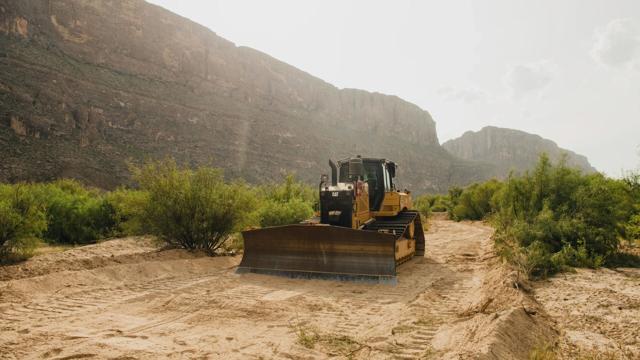
In response to the ruling, Laiken Jordahl with the Center for Biodiversity, said, the ruling “clears the way for contractors to bulldoze pristine desert, dynamite canyon walls and lock away a great American river from us all. And for what? All just to further enrich a few billionaire contractors while they permanently destroy Texas' crown-jewel national park. Because nobody else wants this.”
“The Trump administration and its contractors are hellbent on destroying one of America’s greatest national parks, and the Supreme Court just gave them the green light,” he said, noting that the litigation is ongoing. “This horrific decision clears the way for contractors to bulldoze pristine desert and dynamite canyon walls before the courts have even decided whether this destruction is legal. They’re signing off on the permanent destruction of the wildest place in Texas, and the theft of a great American river from all of us.”
Outgoing Republican U.S. Sen. John Cornyn also sided with plaintiffs, arguing, “A border wall is not the best solution for portions of this environment” and DHS should prioritize “smarter, more cost-effective security measures better suited to the area’s unique terrain.”