Trump administration withdraws suit over California ballots
National News

Audio By Carbonatix
6:10 PM on Monday, November 9
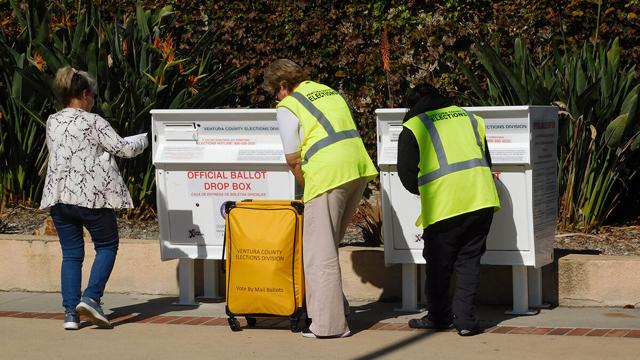
(The Center Square) - The U.S. Department of Justice has dropped its federal lawsuit seeking to require California election officials to set aside roughly 20,000 mail-in ballots cast by individuals suspected of being noncitizens, concluding a rapid legal fight that reached the U.S. Supreme Court.
Justices on Nov. 2, the day before the general election, rejected the Trump administration's appeal seeking to segregate the ballots, as previously reported by The Center Square.
California Attorney General Rob Bonta announced the Trump administration withdrawing the suit, marking an end to the federal government's emergency legal challenges. The decision to drop the case came ahead of an evidentiary hearing scheduled this Friday before U.S. District Judge David Carter in Santa Ana, Calif., where federal prosecutors would have been required to defend the accuracy and methodology related to the list of suspected noncitizens.
"After four court defeats in just one week, including at the U.S. Supreme Court, the federal government has now thrown in the towel," Bonta said in a press release issued Friday night. "California stood firm and prevailed ... California will always stand up for our democracy and the rule of law."
Bonta's office declined an interview with The Center Square. The Center Square also reached out to the White House, the U.S. Department of Justice and the California Republican Party for comment, but did not hear back by publication time.
The federal government's decision to withdraw followed a swift series of judicial rejections across multiple venues in a single week. The pushback began on Oct. 26 when the U.S. Court of Appeals for the 9th Circuit dismissed the administration's initial emergency appeal. Two days later, the U.S. District Court for the Central District of California denied a request for a temporary restraining order.
The legal setbacks continued through the end of the month and into November. On Oct. 30, the Ninth Circuit denied an emergency motion for an injunction pending appeal. The legal effort ultimately stalled at the highest level on Nov. 2, when the U.S. Supreme Court rejected an emergency application seeking to force state election officials to segregate the disputed mail-in ballots.
State officials argued throughout the litigation that under the U.S. Constitution, the authority to regulate the time, place, and manner of elections belongs to the states and Congress, rather than the federal executive branch. Concerns had also been raised in related judicial proceedings regarding the reliability of federal database lists, with DOJ attorneys in separate matters acknowledging high error rates in similar datasets.
However, election integrity advocates caution that the lawsuit's dismissal does not resolve ongoing questions surrounding the accuracy of California's voter registration records.
Hans von Spakovsky, a senior legal fellow and election law expert at the conservative think tank Advancing American Freedom, noted that the decision to drop the lawsuit stems primarily from post-election timing.
"The fact that DOJ has dropped its lawsuit does not mean that California has a clean bill of health over the accuracy of its voter registration list," von Spakovsky told The Center Square. "At this point, the issue of mail-in ballots is moot because the election is over and the ballots have been processed and counted."
Von Spakovsky pointed to systemic vulnerabilities in California's voter registration procedures, including the state's automatic voter registration program at Department of Motor Vehicles offices and its policies regarding citizenship verification.
"Between its automatic voter registration process at the DMV that fails to distinguish between citizens and noncitizens to its refusal to verify citizenship even when it receives evidence that a registered voter is not a citizen, California's voter list is full of mistakes, errors and other problems," said von Spakovsky, who served as counsel to the assistant attorney general for civil rights at the U.S. Department of Justice from 2002 to 2005. "DOJ should continue to investigate and criminally prosecute aliens it finds on the state's voter rolls."